 en
en fr
fr es
es de
de
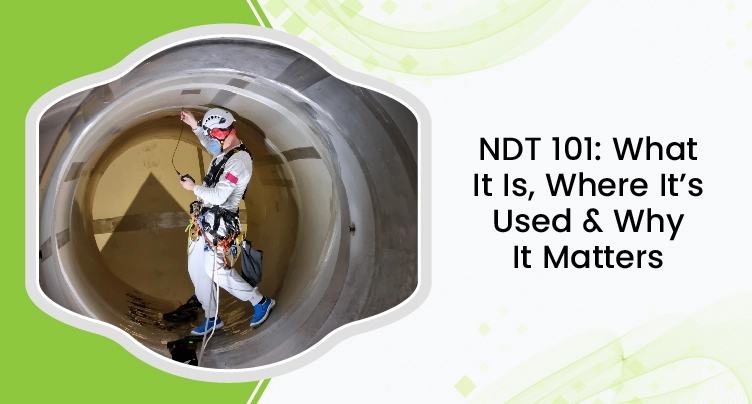
For the industries where safety, reliability and performance are of utmost importance, inspection needs to be accurate and non-invasive. This is where Non-Destructive Testing (NDT) comes into play. With it, businesses can determine the condition of materials and structures without causing any damage. It provides industries with insight to help them maintain quality standards without incurring unnecessary failures.
In this guide, we will explore the basics of NDT, where it is used, why it matters, and much more along the blog. Keep reading!
What Is Non-Destructive Testing?
It is a technique for assessing materials, components or structures without their modification or destruction. This means the tested equipment is able to be used without a problem.
NDT is a process that utilises special techniques to identify surface and internal defects. The most common testing methods are ultrasonic testing, radiographic testing, and magnetic particle testing. These techniques can be used to find cracks, corrosion and inconsistencies.
The main purpose of NDT is to keep things safe, ensure product quality and avoid failures. Industries can carry out precise inspections without compromising productivity with professional solutions provided by Bioscan Ltd.
Ensure safety and reliability with expert NDT solutions from Bioscan Ltd.
Where Is Non-Destructive Testing Used?
The following are the top industries where non-destructive testing is used:
- Manufacturing: Maintains product quality and eliminates defects in manufacturing
- Gas Storage: Detects corrosion on pipelines and storage vessels and identifies any leakages
- Construction: Determines the strength of structures, particularly buildings, bridges, and roads, and evaluates their safety
- Aerospace: Assures that components used in aircraft are safe to use
- Food and Agriculture: Provides quality assurance for food and agricultural products
- Power Plants: Examine boilers, turbines and critical systems
NDT is vital for these industries, helping them avoid failure, meet standards, and run more efficiently. Through the partnership with Bioscan Ltd, businesses can develop and implement efficient inspection systems that enhance safety and performance.
Applications of Non-Destructive Testing
Non-destructive testing has a wide variety of applications and is very important to industries to ensure safety and efficiency. The following is a listing of some applications of non-destructive testing:
- Identifying cracks in metal or weld joints.
- Testing pipelines, tanks, etc., for corrosion.
- The measure of the thickness of materials for evaluation.
- A leak detection system for pressurised systems.
- Stress analysis of industrial equipment
The applications show the importance of NDT for the reliability of various equipment types. Industries can effectively use these applications with Bioscan Ltd.
Advantages of Non-Destructive Testing
Non-destructive testing offers a number of advantages and is commonly employed in several industries.
- No damage to material: Equipment not damaged and is usable
- Easy to maintain in the long run: Avoids the high cost of major failures
- Ensures safe and compliant: Identifies undetected issues at an early stage
- Real-time results and monitoring: helps make rapid decisions
- Minimises downtime: Inspections can sometimes be done without stopping the operation
Bioscan Ltd services enable companies to maximise these benefits and enhance their efficiency and safety.
Difference Between Destructive and Non-Destructive Testing
Destructive Testing (DT): Destructive testing is conducted by subjecting a specimen of material to stress until it fails and cannot be used.
Non-Destructive Testing (NDT): Evaluates materials without damaging the component, which can be returned to use.
Key Differences:
| Destructive Testing (DT) | Non-destructive Testing (NDT) | |
| Material Damage | DT damages the sample | NDT does not |
| Cost | DT will involve the replacement of the tested parts, which is more expensive. | NDT will be more cost-effective. |
| Purpose | DT is used for testing performance limits. | NDT is used for inspection and maintenance without damaging the specimen. |
| Reusability | No | Components tested using NDT can be used. |
In industries where operational continuity is the key focus, NDT is highly advised.
What Are the Limitations of NDT?
Although NDT is very effective for businesses with operational continuity, it’s important to know its limitations.
- Several approaches are shallow or only detect a small amount of information.
- Needs expert technicians to get precise outcomes
- Some NDT equipment can be expensive.
- Some defects can only be found using multiple methods
- Interpretation of results may vary
Such restrictions underscore the need to hire an experienced industrial inspection company, such as Bioscan Ltd, to get precise and dependable results.
Why Choose Professional Industrial NDT Inspection Services
Choosing professional industrial NDT inspection services is a wise decision for numerous reasons. Professional inspection services play a crucial role in ensuring accurate results and minimising risks.
Bioscan Ltd provides complete and versatile industrial NDT inspection solutions that meet industry requirements.
Their services include:
- Advanced inspection equipment
- Qualified and experienced engineers
- Comprehensive and correct reporting.
- Meeting industry safety requirements
Bioscan Ltd offers businesses the ability to minimise operational risks, improve safety, and guarantee the long-term performance of their equipment.
Detect issues early and avoid costly failures with professional NDT services.
Conclusion
From safety to efficiency, and from reduced downtime to performance optimisation, NDT plays a crucial role in the operational efficiency of the oil and gas industry. There are some limitations, but the advantages of non-destructive testing are enormous. With an established industrial inspection company like Bioscan Ltd, businesses can ensure that their inspections are accurate, their equipment complies with regulations, and they can rely on it for years and years to come. Contact us now!
FAQs
1. What are the different NDT techniques?
These methods are commonly used: ultrasonic testing, radiographic testing, magnetic particle testing, or visual inspection.
2. How long does it take to get NDT certified?
The certification period will depend on the level and method and is usually between weeks and months.
3. What certification is best for NDT?
Programmes such as ASNT or ISO-based programmes are industry-recognised certifications.
4. How to do NDT testing?
NDT testing involves using specialised tools and trained professionals to inspect materials without causing damage.
5. What are common NDT techniques?
Some of the most popular methods include ultrasonic, radiographic, magnetic particle, and visual testing.
