 en
 fr
 es
 de

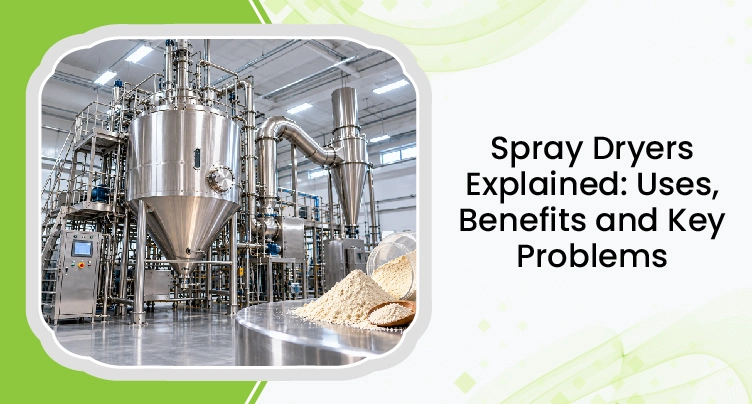
A spray dryer does more than remove moisture from a liquid feed. It converts liquids, slurries, or suspensions into a dry powder in a controlled process used across pharmaceutical, food, chemical, and speciality manufacturing. For this process to remain consistent, the drying chamber, atomisation system, air-handling components, and collection system must continue to perform reliably. Continuous exposure to heat, moisture, chemicals, and high-velocity particles can gradually lead to corrosion, cracking, erosion, product buildup, or connection damage.
Understanding spray dryer uses and benefits alongside common spray dryer problems helps operators recognise how equipment condition can affect performance and when professional inspection may be required.
Keep your spray dryer in reliable operating condition with professional inspection and NDT support.
What Is a Spray Dryer, and How Does the Spray Drying Process Work?
Spray dryers dry a liquid or slurry to a dry powder by rapidly evaporating the moisture content. While the concept is simple, the various stages are critically dependent on equipment functioning as intended and operating conditions being carefully controlled.
Feed Preparation
The first step is the preparation of the liquid, slurry or suspension to be dried. The feed should possess appropriate atomisation properties and be suitable for processing. The drying behaviour and the quality of the powders can be affected by changes in the properties of the feed.
Atomisation
The dried feed is added to the drying chamber via an atomiser or appropriate spraying system. It is divided into fine droplets which provide more surface for moisture removal.
Exposure to hot air
The atomised droplets are contacted by heated drying air. Moisture removal is affected by the temperature, airflow and contact conditions.
Moisture Evaporation
The droplets meet with hot air, and moisture evaporates quickly. The remaining solids are in dry particles. The internal surfaces and the chamber need to resist the thermal and process conditions.
Powder Collection
The dried particles are removed from the flow of air and are gathered for additional processing or packaging. The collection equipment and associated components should be in good working order to ensure the efficiency of the process.
Inspection of the dryer chamber, welds, connections, surfaces and other critical areas can help to detect any deterioration that may occur and result in unreliable operation because these stages rely on multiple components.
Spray Dryer Applications and Benefits in the Industry
Spray drying is useful to several industrial sectors because it allows for converting liquid materials into dry materials that are easier to handle. The benefits of spray dryers will depend on product and process needs.
Pharmaceutical Manufacturing
In pharmaceutical manufacturing, spray drying is used to convert liquid formulations, solutions, or suspensions into dry powders with controlled characteristics. By adjusting feed conditions, atomisation, and drying parameters, manufacturers can influence moisture content, particle size, and powder properties required for further processing. The process is particularly useful where consistent powder characteristics are important for formulation, handling, storage, or downstream manufacturing.
Food and Beverage Processing
Spray drying is widely used in food processing to produce powders such as flavours, extracts, nutritional ingredients, powdered milk, and other food products. Consistent drying can help achieve the required moisture level and powder characteristics, supporting product quality, storage, and handling. Since these applications involve continuous operation and strict hygiene requirements, the condition of the spray dryer and associated equipment also needs attention. Regular food industry inspection can help identify corrosion, cracks, surface deterioration, or other equipment issues that may affect safe and reliable processing.
Chemical Manufacturing
Spray drying can be used by chemical manufacturers to convert a liquid chemical formulation or suspension into a dry product that can be more easily stored, transported, handled or used in other processes.
Speciality & Industrial Powders
In speciality and industrial powder manufacturing, spray drying helps convert liquid feeds into powders with characteristics suited to specific processing requirements. Parameters such as atomisation, drying temperature, and feed composition can influence moisture content, particle size, and powder structure. This makes spray drying useful where consistent powder properties are needed for handling, storage, blending, or subsequent manufacturing processes.
Common Spray Dryer Problems that Can Affect Spray Dryer Performance
The equipment is subjected to high stress during spray drying. These conditions may lead to various degrees of deterioration over time.
Corrosion and Surface Deterioration
Equipment surfaces can be impacted by moisture, chemicals, cleaning procedures and exposure to products. Chambers, connections, welds and other exposed surfaces should be checked for corrosion, staining, pitting or other signs of material deterioration.
Cracks and Weld Defects
Cracks or weld defects can be caused by repeated thermal cycling, mechanical stress and vibration, and fabrication problems. Such high-stress areas may thus need more attention. They may need to be monitored, may need repair, or may require further investigation, depending on their size and location. When a defect is suspected, the appropriate industrial crack testing can help to determine the defect.
Erosion and Wall Thinning
Exposed surfaces can be abraded over time by high-velocity particles and continuous flow of product. Depending on the airflow and movement of material, erosion can occur in certain parts of the dryer.
Thickness measurement can be helpful where the loss of material is suspected and is not always evident. The outcome can aid in determining the degree of degradation and if corrective measures are warranted.
Product Build-Up & Deposits
Process conditions, product characteristics or equipment operation can create deposit conditions on internal surfaces that lead to powder accumulation. When there is over-accumulation, heat transfer, process efficiency, cleaning and product handling can be impacted.
Inspection can be used to decide if surface condition or equipment operation needs attention and can be used to find areas where deposits are building up.
Leakage or Damaged Connections
Over extended periods of use, flanges, joints, seals, access points and other connections can deteriorate. If leakage is seen, the seals may be damaged, connections may be loose, corrosion, cracking or mechanical problems may be present that need to be investigated.
Deformation or Structural Damage
Equipment geometry can be influenced by thermal stresses, mechanical loads, pressures and other operating conditions. Dents, distortions, buckling, or other abnormal changes should be investigated immediately to determine the cause and impact of such changes on equipment integrity.
Spray Dryer Inspection Services offered by Bioscan Ltd.
Bioscan Ltd. is an industrial inspection and NDT company for spray dryers and related process equipment. Our spray dryer inspection is highly regarded for gaining a picture of the equipment condition and areas that need further inspection.
The assessment will cover:
- Assessment of conditions and integrity of equipment.
- The identification of cracks and surface defects.
- Assessment of deterioration and corrosion.
- Evaluation of welds, joints and areas of critical importance.
With BioScan LTD, the facility can early identify the deterioration. It tremendously helps assist the operator in planning maintenance and repair, investigating recurring problems, and planning equipment condition.
How to Maintain Spray Dryer Reliability After Inspection
Inspection provides useful information, but its value depends on what happens afterwards. Once defects or vulnerable areas have been identified, maintenance decisions should be based on the inspection findings and the equipment’s operating requirements.
- Identified defects should be addressed according to their severity and the recommendations of the inspection. If repair or component replacement is required, it should be completed within the appropriate maintenance plan.
- Previously vulnerable areas should also be monitored during subsequent inspections. Cleaning and operating procedures should be maintained appropriately to minimise conditions that contribute to deposits, corrosion, or accelerated deterioration.
- Periodic inspections should be scheduled according to equipment condition, operating environment, and maintenance requirements. Keeping inspection and repair records can also help identify recurring problems and track how equipment condition changes over time.
Conclusion
Understanding spray dryer uses and benefits is only one part of maintaining reliable drying operations. The same equipment that provides controlled moisture removal and powder production can experience common spray dryer problems, including corrosion, cracking, erosion, product buildup, connection damage, and deformation during continuous operation. These conditions can develop gradually and may not always be obvious from routine observation.
A structured spray drying process assessment should therefore consider both process performance and equipment condition. Regular inspection can identify deterioration, assess critical areas, and provide information for maintenance decisions. With appropriate inspection, repair, monitoring, and operating practices, manufacturers can better protect spray dryer integrity and support consistent long-term operation.
Need to assess your spray dryer? Speak with Bioscan’s inspection specialists about the condition of your equipment. Talk to Our Inspection Specialists now!
