English Bag Filter Integrity Why Crack Testing And Rope Access Inspection Matter More Than You Think

Bag Filter Integrity: Why Crack Testing and Rope Access Inspection Matter More Than You Think

A bag filter is running fine on paper. Pressure readings are normal, output looks steady, nobody’s complaining. Then somebody notices a faint dust trail near a seam that shouldn’t be there. By the time it’s investigated, there’s a crack in the housing that’s been growing for months.

Most bag filter advice focuses on the operational side of things: bags, cages, cleaning cycles, differential pressure. That’s all useful, but none of it says anything about the structural condition of the vessel itself. A bag filter can have perfect airflow and still have a crack working its way through a weld seam that nobody’s checked in years. This article is about that other side of maintenance: how structural defects develop, why they’re so easy to miss, and what it actually takes to catch them before they become a bigger problem.

Why Structural Integrity Gets Overlooked?

Bag filters are built to handle constant airflow, temperature cycling, and dust loading, day after day, for years. That kind of sustained stress on welds and shell metal eventually shows up somewhere, usually at the points under the most strain: weld seams, the transition into the hopper, and cage support fittings.

The problem is that none of this registers on the instruments plants normally rely on. A pressure gauge tells you how the filter is performing, not what condition the metal is in. So a vessel can pass every operational check and still be quietly developing a structural fault underneath.

Ensure peak baghouse performance with expert inspection today.

Book Inspection Now

What Structural Defects Actually Look Like?

The issues that matter here aren’t the ones you’d catch from outside the vessel.They include:

  • Cracks along the shell or weld seams
  • Welds that were never completed properly, or carried defects from the original fabrication
  • Corrosion, pitting, and small cavities in the metal
  • Porosity inside the weld material itself
  • Thinning or weak spots in the shell wall

Left alone, any of these can progress into dust leakage, an emissions compliance issue, or, in serious cases, structural failure. And because none of them affects day-to-day performance until they’re advanced, the only reliable way to catch them early is to physically inspect the metal.

The Real Obstacle: Getting Inside

This is where most inspection plans run into trouble. Bag filters have limited entry points, and their internal layout varies from one design to the next, which makes the areas most likely to crack some of the hardest to physically reach.

Traditionally, that’s meant scaffolding. It gets the job done, but it’s slow and expensive, and the unit typically sits offline for the entire build before anyone has even looked at the metal. On a lot of sites, the cost of the scaffold ends up outweighing the cost of whatever the inspection actually finds. The access method, more than the inspection itself, is usually what drives the downtime and the bill.
A Faster Way In: Rope Access Inspection

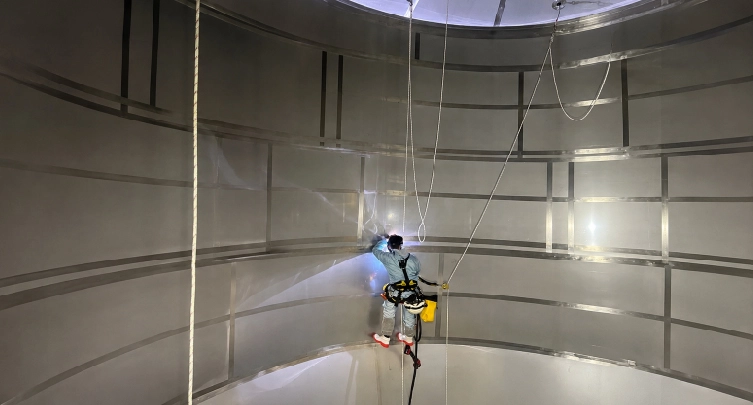
Rope access changes that equation. IRATA-certified technicians, working with ropes, anchors, harnesses and descenders, can reach the internal surfaces of a bag filter through openings the vessel already has, such as CIP nozzles, manways, and the bag and cage entry points. No scaffold needs to go up, and no weeks of planning are required around a scaffold build.

Done this way, it’s possible to reach 100% of the internal surface in a matter of hours rather than days. That means the areas most prone to cracking, the ones scaffolding often struggles to reach efficiently, get checked properly, not just the sections that happen to be accessible.

Inspection and Repair, Without a Second Visit

One of the practical advantages of this approach is that repair doesn’t have to wait for a second mobilisation. If a crack, weld defect, or area of corrosion turns up during inspection, welding repairs and polishing can often be carried out on the spot.

That said, the job isn’t finished once a weld is repaired. The heat-affected zone (HAZ) around a fresh weld needs to be re-checked, since welding can introduce its own stresses and occasionally its own defects. Re-inspecting the HAZ is what confirms a repair has actually held, rather than just assuming it has.

The Downtime Case for Doing It This Way

Put together, this approach offers a few clear advantages over scaffold-based inspection:

  • Full coverage of internal surfaces, with no scaffold required
  • Defects found and mapped using NDT methods
  • Inspection and repair handled in a single mobilisation
  • Typical turnaround of 4 to 12 hours, depending on size and repair scope
  • A fraction of the downtime that scaffold-dependent inspection usually involves

For plants running tight schedules, that difference in downtime is often what makes structural inspection worth prioritising in the first place, rather than something that gets pushed back every planning cycle.

Who to Bring In for This Work

This isn’t a job for a general inspection contractor. It requires rope access certification, genuine NDT expertise, and welding capability, ideally within the same team, since splitting inspection and repair across separate contractors reintroduces the delay this whole approach is meant to avoid.

Bioscan Ltd. carries out crack testing, inspection, and repair of cyclones and bag filters using IRATA-certified rope access, reaching full internal coverage without scaffolding. Where defects are found, welding repair and the follow-up HAZ re-inspection are carried out in the same visit, so plants aren’t left waiting on a second mobilisation to get back into production.

Reduce downtime and maximise filtration efficiency effortlessly.

Get Started Today

Conclusion

Bag filter integrity isn’t just about how well the system is running. It’s about whether the vessel itself is still sound underneath the operation. Regular structural inspection, done through rope access rather than scaffolding, is what catches cracks and weld defects before they turn into leaks, compliance issues, or unplanned downtime. It’s a smaller job than most plants expect, provided it’s done by people equipped to inspect, repair, and re-check all in one visit.

Working with trusted experts such as Bioscan Ltd., a trusted industrial inspection company, will further bolster maintenance activities, ensuring that you are informed with expert advice and accurate diagnostic data. Contact us now!

FAQs

1. What are the benefits of preventive baghouse maintenance?

Preventive maintenance maximises efficiency, minimises downtime, increases filter life and helps meet environmental standards, all of which will reduce operational costs.

2. How can regular baghouse inspections reduce operational costs?

Inspections detect problems at an early stage, thereby avoiding major failures, repair cost and production downtime.

3. How often should baghouse filters be inspected?

Periodic inspection is recommended, usually every few months or annually for detailed inspection, depending on filter usage.

4. How can you extend the life of bag filters?

Ensure adequate cleaning cycles, maintain operating conditions and regular inspections to avoid damage and wear.

5. How can industries improve baghouse filtration efficiency?

Through the optimisation of airflow, keeping cleaning systems, monitoring the pressure level and having professional inspection services.
Read More
silo tank inspection by Bioscan

How Common Silo Maintenance Mistakes Turn Into Expensive Industrial Tank Repairs

In many manufacturing processes like food processing, pharmaceuticals, bulk material processing, etc., silos and industrial storage tanks are important assets. They provide product security, quality and continuous production cycles. But without adequate maintenance or maintenance poorly executed, these essential systems can easily become a source of high cost repairs and operational risk. Residue build-up or even undiscovered cracks are common problems that can lead to big structural problems, contamination risks or extended downtime. Delving into the cause or causes of these failures is essential. 

This article identifies the most prevalent issues with silo maintenance and illustrates the consequences of each issue and how they can be avoided with a proactive approach to the maintenance of industrial tanks.

Why Silo Maintenance Cannot Be an Afterthought 

In certain highly regulated industries such as food and pharmaceuticals, silos and industrial tanks are crucial to product integrity and production process continuity. Any maintenance failure, no matter how minor, can lead to contamination or collapse or even unexpected shutdowns.

In most instances, major failures are not the result of a single catastrophic incident but rather are the consequence of unnoticed small problems that slowly get worse over time. Cracks, corrosion or build-up of material usually occur and are not noticed until they cause an issue. That is why it’s so important to have preventive silo maintenance.

It is important to work in partnership with an experienced industrial inspection firm such as BioScan Ltd. so that any potential problems are recognised at an early stage. When it comes to industrial tanks, it is essential that there are no hidden issues. By ensuring there are no hidden defects, professional tank inspection can help prevent the need for expensive repairs and ensure that the tanks will run smoothly for years to come.

Ensure safety and reliability with expert NDT solutions from Bioscan Ltd.

Schedule Inspection

Common Silo Maintenance Mistakes That Lead to Costly Repairs

Top 7 silo maintenance pitfalls and the impact that leads to costly repairs:

1. Skipping or Delaying Routine Industrial Tank Inspection

One of the biggest and most expensive errors is that of delayed inspections. The small cracks, corrosion or weaknesses in the structure can only be evidenced by its failure. These issues can be detected early and minimises repair costs through regular industrial tank inspection.

2. Relying Only on Visual Checks to Assess Vessel Condition

Micro-cracks and internal stress fractures are hard to detect in a visual inspection or by camera. Over time these hidden flaws undermine the structural strength. Advanced diagnostics methods are required for correct assessment.

3. Ignoring Material Buildup and Residue Inside the Vessel

The residue can harden over time, which diminishes storage space, and stresses mechanical parts. It also raises the contamination risk in food and pharma industries, making the maintenance of industrial storage tanks paramount.

4. Overlooking Temperature-Related Structural Fatigue

When metal surfaces are heated and cooled often, they expand and contract. This causes fatigue cracks which helps to weaken the structure over time. If not monitored properly, these can cause an abrupt failure.

5. Delaying Component Replacement Until Failure Occurs

When components, such as discharge valves, seals, or sensors, fail, it can cause disruptions in operations. This needs to be replaced on time to ensure the efficiency and avoid major damage to the system.

6. Neglecting Silo Tank Condition Monitoring Between Production Cycles

There are many facilities that only do scheduled shutdown inspections but do not do continuous monitoring. This will create blind spots in which damage can occur without anyone realising. Silo tank condition monitoring is ongoing to ensure system health.

7. Using Inadequate Repair Methods or Non-Rated Materials

Simple or inadequate repairs can aggravate the situation. Non-certified materials and/or improper installation technique can threaten safety and structural integrity over time.

The Real Cost of Poor Industrial Storage Tank Maintenance

If steel silo maintenance is not conducted, significant financial and operating implications can occur. Contamination is a significant worry, especially in the food business and pharmaceutical industries, where it might result in costly recalls and adherence concerns.

Inadequate maintenance reduces the storage tank longevity, causing early replacement expense. Failure to comply with the regulations may also lead to fines and closures.

In addition to the financial damage, the damage caused to reputation can be quite significant, particularly in industries where quality and safety are paramount. The risks are clear and show that preventive silo maintenance is much cheaper than reactive repairs.

What Effective Steel Silo Maintenance Should Include

A good maintenance programme is more than a checklist of periodic checks. It should feature both internal and external evaluations as well as the use of advanced technologies that can identify defects that are not visible.

Today’s inspection techniques can detect cracks, corrosion and stress fractures that are not visible without using dyes or chemicals. Continuous silo tank condition monitoring allows for tracking to identify issues in real time and not just during shutdown.

Repairs are also crucial to make at the right time. If defects are caught early, they are not likely to turn into structural issues. Crack depth analysis, imaging and 3D mapping are part of the detailed inspection report, enabling audit readiness and regulatory compliance.

By following international safety standards, industrial storage systems can achieve reliability, safety, and performance that last for years.

How Bioscan Supports Preventive Silo Maintenance

BioScan Ltd. provides innovative solutions in the field of industrial tank maintenance with the most modern electronic crack testing technology. It is considered one of the most accurate ways to identify hidden structural faults in silos and tanks.

This technology is able to detect micro-cracks, stress fractures and internal damage, which other traditional visual or dye-based methods can not detect. Inspections are done within 12 to 48 hours, keeping production up and moving quickly, so decisions can be made faster.

BioScan not only performs inspection but also has in-house repair activities so that any defects can be corrected as soon as they are detected. A detailed report will be generated after each inspection, and certification will be issued to ensure compliance and complete transparency for industrial operations.

Ensure Reliable Tank Performance Year-Round

Get Expert Support

Conclusion

Properly maintaining silos isn’t just a routine job; it’s a key component to making a facility efficient and safe to operate and managing costs. Lots of damages are preventable errors which cause most of the expensive repairs; these include delayed inspection, monitoring and repair methods which are not suitable. A proactive industrial tank maintenance strategy can help businesses avoid structural issues, minimise downtime, and maximise equipment longevity.

Joining forces with experts such as BioScan Ltd., a renowned industrial inspection company, can help industries identify problems early, provide effective solutions, and ensure adherence to safety standards. Preventative maintenance of the silos is a worthwhile investment that guarantees long-term reliability, lower maintenance expenses and continuous industrial processes.

FAQs

1. Can professional silo inspection services extend equipment life?

Yes, periodic inspection detects defects at an early stage and a timely repair will greatly prolong the life of silos or storage tanks.

2. How can regular industrial tank maintenance reduce repair costs?

Routine maintenance keeps small problems from becoming big problems, thus limiting the need for costly repairs and downtime.

3. How does NDT help in industrial tank maintenance?

A non-destructive testing (NDT) method is used to identify hidden cracks and structural weaknesses without causing any damage to the equipment, which helps to accurately assess its condition and operate safely.

4. What are signs that an industrial tank needs immediate inspection?

The symptoms may be that it has some unusual pressure changes, visible cracks, leaks, unusual noise or loss of efficiency in operation.

5. What are the most common steel silo maintenance issues?

Some of the problems are corrosion, material deposition, structural fatigue, damaged components and undetected cracks from bad inspection.

Read More
NDT Inspection

NDT 101: What It Is, Where It’s Used & Why It Matters

For the industries where safety, reliability and performance are of utmost importance, inspection needs to be accurate and non-invasive. This is where Non-Destructive Testing (NDT) comes into play. With it, businesses can determine the condition of materials and structures without causing any damage. It provides industries with insight to help them maintain quality standards without incurring unnecessary failures. 

In this guide, we will explore the basics of NDT, where it is used, why it matters, and much more along the blog. Keep reading!

What Is Non-Destructive Testing?

It is a technique for assessing materials, components or structures without their modification or destruction. This means the tested equipment is able to be used without a problem.

NDT is a process that utilises special techniques to identify surface and internal defects. The most common testing methods are ultrasonic testing, radiographic testing, and magnetic particle testing. These techniques can be used to find cracks, corrosion and inconsistencies.

The main purpose of NDT is to keep things safe, ensure product quality and avoid failures. Industries can carry out precise inspections without compromising productivity with professional solutions provided by Bioscan Ltd.

Ensure safety and reliability with expert NDT solutions from Bioscan Ltd.

Book Inspection Now

Where Is Non-Destructive Testing Used?

The following are the top industries where non-destructive testing is used:

  • Manufacturing: Maintains product quality and eliminates defects in manufacturing
  • Gas Storage: Detects corrosion on pipelines and storage vessels and identifies any leakages
  • Construction: Determines the strength of structures, particularly buildings, bridges, and roads, and evaluates their safety
  • Aerospace: Assures that components used in aircraft are safe to use
  • Food and Agriculture: Provides quality assurance for food and agricultural products
  • Power Plants: Examine boilers, turbines and critical systems

NDT is vital for these industries, helping them avoid failure, meet standards, and run more efficiently. Through the partnership with Bioscan Ltd, businesses can develop and implement efficient inspection systems that enhance safety and performance.

Applications of Non-Destructive Testing 

Non-destructive testing has a wide variety of applications and is very important to industries to ensure safety and efficiency. The following is a listing of some applications of non-destructive testing:

  • Identifying cracks in metal or weld joints.
  • Testing pipelines, tanks, etc., for corrosion.
  • The measure of the thickness of materials for evaluation.
  • A leak detection system for pressurised systems.
  • Stress analysis of industrial equipment

The applications show the importance of NDT for the reliability of various equipment types. Industries can effectively use these applications with Bioscan Ltd.

Advantages of Non-Destructive Testing

Non-destructive testing offers a number of advantages and is commonly employed in several industries.

  • No damage to material: Equipment not damaged and is usable
  • Easy to maintain in the long run: Avoids the high cost of major failures
  • Ensures safe and compliant: Identifies undetected issues at an early stage
  • Real-time results and monitoring: helps make rapid decisions
  • Minimises downtime: Inspections can sometimes be done without stopping the operation

Bioscan Ltd services enable companies to maximise these benefits and enhance their efficiency and safety.

Difference Between Destructive and Non-Destructive Testing

Destructive Testing (DT): Destructive testing is conducted by subjecting a specimen of material to stress until it fails and cannot be used.

Non-Destructive Testing (NDT): Evaluates materials without damaging the component, which can be returned to use.

Key Differences

Destructive Testing (DT) Non-destructive Testing (NDT)
Material Damage DT damages the sample NDT does not
Cost DT will involve the replacement of the tested parts, which is more expensive. NDT will be more cost-effective.
Purpose DT is used for testing performance limits. NDT is used for inspection and maintenance without damaging the specimen.
Reusability No Components tested using NDT can be used.

In industries where operational continuity is the key focus, NDT is highly advised.

What Are the Limitations of NDT?

Although NDT is very effective for businesses with operational continuity, it’s important to know its limitations.

  • Several approaches are shallow or only detect a small amount of information.
  • Needs expert technicians to get precise outcomes
  • Some NDT equipment can be expensive. 
  • Some defects can only be found using multiple methods
  • Interpretation of results may vary

Such restrictions underscore the need to hire an experienced industrial inspection company, such as Bioscan Ltd, to get precise and dependable results.

Why Choose Professional Industrial NDT Inspection Services

Choosing professional industrial NDT inspection services is a wise decision for numerous reasons. Professional inspection services play a crucial role in ensuring accurate results and minimising risks. 

Bioscan Ltd provides complete and versatile industrial NDT inspection solutions that meet industry requirements.

Their services include:

  • Advanced inspection equipment
  • Qualified and experienced engineers
  • Comprehensive and correct reporting.
  • Meeting industry safety requirements

Bioscan Ltd offers businesses the ability to minimise operational risks, improve safety, and guarantee the long-term performance of their equipment.

Detect issues early and avoid costly failures with professional NDT services.

Get a Free Consultation

Conclusion

From safety to efficiency, and from reduced downtime to performance optimisation, NDT plays a crucial role in the operational efficiency of the oil and gas industry. There are some limitations, but the advantages of non-destructive testing are enormous. With an established industrial inspection company like Bioscan Ltd, businesses can ensure that their inspections are accurate, their equipment complies with regulations, and they can rely on it for years and years to come. Contact us now!

FAQs

1. What are the different NDT techniques?

These methods are commonly used: ultrasonic testing, radiographic testing, magnetic particle testing, or visual inspection.

2. How long does it take to get NDT certified?

The certification period will depend on the level and method and is usually between weeks and months.

3. What certification is best for NDT?

Programmes such as ASNT or ISO-based programmes are industry-recognised certifications.

4. How to do NDT testing?

NDT testing involves using specialised tools and trained professionals to inspect materials without causing damage.

5. What are common NDT techniques?

Some of the most popular methods include ultrasonic, radiographic, magnetic particle, and visual testing.

Read More